
Women and Girls in STEM 2026: The female students are ready – but is the research world?
Is there still a need for a day dedicated to women and girls in STEM? Yes, say two upper-secondary students who would not rule out a future in science. But is the research world ready to meet them – or do outdated structures still stand in their way?

Every year, the World Day of Women and Girls in Science highlights the importance of gender equality in science, technology, engineering, and mathematics. But in 2026, is there still a need for such a day? According to those it concerns most, the answer is a clear yes.
Hope for the same opportunities as boys
Two of them are Thea and Isabella, upper-secondary students in their final year, specialising in biotechnology. Both hope to study medicine in the future. For them, gender is not a personal barrier – yet they clearly see differences between fields:
“In our class, there are more girls than boys in biotechnology, but in physics, it’s mostly boys. It really depends on the subject,” they explain.
At the same time, they experience that their education actively highlights women in science:
“Our biotechnology teacher is a woman, and she’s really good at showing us the women who are already part of the science world. We often read research made by women and visit female researchers at the university,” says Thea.
When asked whether gender imbalance influences their own educational choices, they are unequivocal:
“We know there are a lot of men in science, but it doesn’t scare us away. It would be sad if it did for others. Everyone should have equal opportunities.”
Isabella emphasises that equality is a fundamental principle for them:
“Everyone should have equal chances in everything, also in the science world. I hope we get the same opportunities as boys when we get older.”
A glimpse into the research world
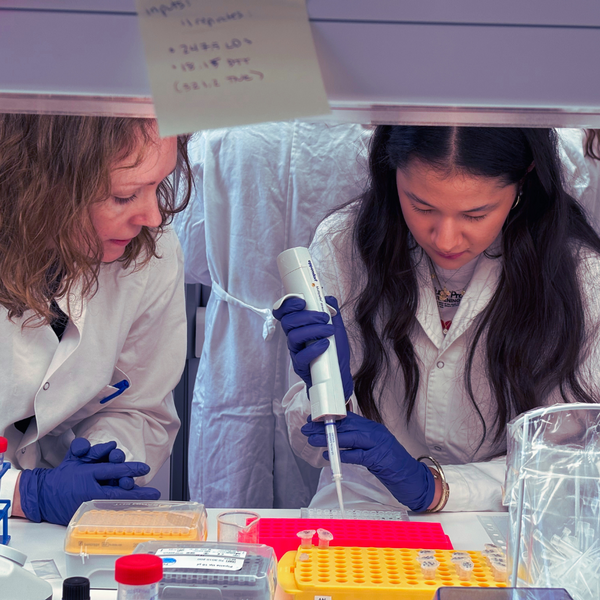
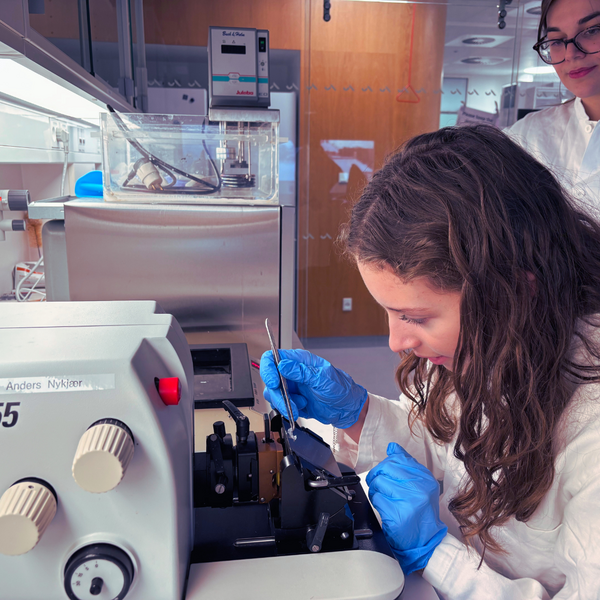
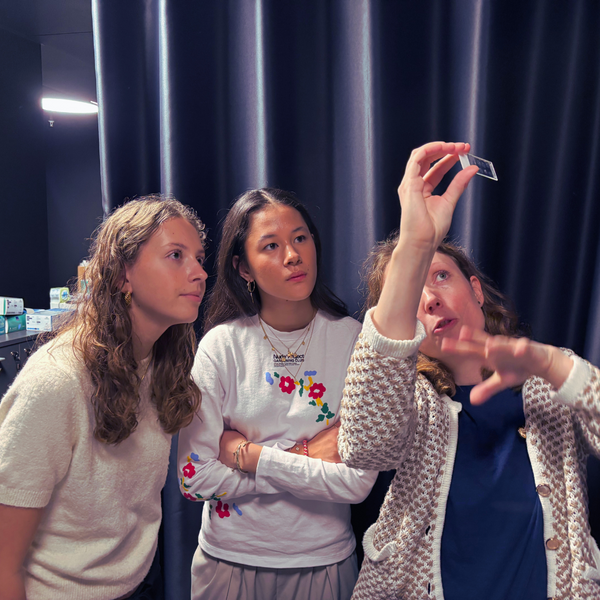
As part of the day’s activities, the students were invited to shadow two female researchers from DANDRITE for a day. The aim was to give them an insight into life as a scientist, both the academic work and the personal choices that shape a career in research.
Their guides for the day were postdoctoral researchers Karen Marie Juul Sørensen and Pia Boxy. While DANDRITE has a relatively high proportion of female researchers, the two researchers still see significant challenges ahead.
According to Karen Marie Juul Sørensen, the issue becomes particularly clear at senior levels:
“If you look at seniority right now, most group leaders are still men – and they are mostly chosen by men. So there needs to be a focus on making sure that women are valued equally,” she says.
At the same time, she stresses that the solution cannot be based on gender quotas:
“I would never want to be chosen just because I’m a woman. It has to be about skills, not gender – but we also need to make sure it doesn’t become a men’s club selecting people who look like themselves.”
Pia Boxy feels that progress is being made – but slowly:
“It is getting better, but it’s a very slow process. The right infrastructure is important, especially when it comes to combining a research career with family life.”
Both point to maternity leave as a particular structural challenge within academia:
“When you go on maternity leave, your contract is put on hold – but so is your project. That’s very different from many other fields where someone can cover for you,” explains Karen Marie Juul Sørensen.
For this reason, the researchers believe that days like this are still essential:
“We need to highlight how far we’ve come – but also how far we still have to go,” says Pia Boxy.
Inspiration for the next generation
After a day in the laboratories, Thea and Isabella take more with them than just academic knowledge.
“I feel like I’ve gained a lot of new knowledge – but also that I’ve been really supported here. It’s great to meet women who work in science and are ready to help and answer all our questions,” says Isabella.
For Isabella, the visit also provided a clearer picture of everyday life as a researcher:
“I’m not only taking technical knowledge with me, but also an understanding of what daily life as a scientist is really like. I feel very inspired.”
According to both the students and the researchers, inspiration is exactly the purpose of the World Day of Women and Girls in Science: to show the next generation that they belong in science – and that the path ahead is open to them.